

Twenty-nine years ago today, Final Fantasy Tactics launched for PlayStation in Japan and proved that Final Fantasy did not need an active-time battle gauge to feel like Final Fantasy. It could move to an isometric grid, slow the pace down, ask players to think in squares, heights and turn order, then still hit with the kind of sweeping drama the series had made its name on.
That was not an obvious promise in 1997. Final Fantasy VII had only arrived in Japan a few months earlier, pushing Square's flagship RPG into cinematic 3D and turning Cloud, Midgar and pre-rendered spectacle into the future most players could see. Tactics took the opposite route. It looked smaller at first glance, with squat characters standing on tiled battlefields, but it made that intimacy feel dangerous. Every unit placement mattered. Every job choice could change a run. Every noble speech in Ivalice carried the suspicion that someone poorer would pay for it.
The result became one of the great side paths in Final Fantasy history, and maybe the one that best explains how flexible the series could be. Final Fantasy Tactics did not feel like a spin-off built from leftovers. It felt like a different school of RPG design getting access to Final Fantasy's language of jobs, summons, crystals, Chocobos and melodrama.
Ivalice made strategy feel personal
Final Fantasy Tactics opens around young nobles, military academies and a kingdom still scarred by the Fifty Years' War. Its central figures, Ramza Beoulve and Delita Heiral, begin close enough to seem bound by fate. The game spends the rest of its story pulling them through class resentment, church politics, false history and war until that bond becomes something sharper.
That is the reason Ivalice still has such a hold on players. The setting is not only a fantasy backdrop with banners and castles. It is a place where birth decides opportunity, faith becomes a political weapon and battlefield heroism can be rewritten by whoever survives with authority. Final Fantasy had already told grand stories before Tactics, but this one felt colder. It was less interested in saving the world with destiny than in asking who gets remembered as a hero when the records are written.
That tone came from a creative lineage players could feel even if they did not know the names at the time. Yasumi Matsuno's political storytelling, Hiroshi Minagawa's art direction and Akihiko Yoshida's character work gave Tactics a different weight from the mainline games around it. It shared Final Fantasy DNA, but it also carried the sharper tactical sensibility of the Ogre Battle and Tactics Ogre tradition. Square was not just making Final Fantasy chess. It was blending two approaches to RPG drama and letting them argue inside the same game.
The first hours tell players exactly what kind of story this will be. Ramza is a noble who wants to believe in justice. Delita understands earlier than Ramza that justice is easier to admire when it has not crushed your family. Their split gives the battles emotional context. You are not just pushing a knight up a slope because the hit rate is better there. You are watching two young men learn that the rules of their world were written before either of them got a turn.
The job system was the real addiction
Final Fantasy Tactics has one of those systems that sounds straightforward until it eats an evening. Characters gain job points, spend them on abilities, move into new jobs and carry useful skills across roles. A knight can borrow support tools from another class. A black mage can become something stranger after enough experimentation. A weak unit can become a project. A favorite unit can become a liability if you refuse to adapt.
Final Fantasy had used jobs before, most famously in Final Fantasy III and Final Fantasy V, but Tactics made them spatial. A dragoon's jump was not just a command. It was a question of timing, elevation and where the enemy would be when the attack landed. A chemist's item range could save a fight because the map made a white mage too slow. A time mage was not only a source of buffs, but a way to bend the entire tempo of battle.

That is where Tactics became sticky. It was not content to let players choose a party and coast. Its battles pushed back with height advantages, charging spells, status effects, guests who made questionable decisions and enemies who could punish sloppy movement. Even victory had a little tension. Fallen allies could vanish permanently if ignored too long, which made the end of a messy fight feel like a rescue mission.
The system also had the delicious imbalance that many beloved RPGs carry. Players found broken combinations, monster units, calculator tricks and ways to make Ramza absurdly strong. Instead of making the game feel thin, that freedom became part of its legend. Final Fantasy Tactics invited mastery, but mastery did not mean playing cleanly. It often meant building something so clever and unfair that Ivalice finally bent back.
A side story that became a pillar
The strangest thing about Final Fantasy Tactics now is that it no longer feels like a side road. Ivalice became one of Square's most recognizable worlds, returning through Final Fantasy Tactics Advance, Final Fantasy XII, Final Fantasy Tactics A2 and later Final Fantasy XIV's Return to Ivalice raids. Names, places, imagery and themes from Tactics kept echoing because the original game had built more than a map. It had built a political texture.
That texture is why fans still talk about Ramza and Delita differently from many RPG heroes. Ramza's arc is not about becoming the loudest champion in history. Delita's is not a simple fall into villainy. The game is fascinated by how power uses people, and how good intentions can look naive beside someone willing to seize the pen that writes the official story. For a PlayStation RPG released during a year of giant genre milestones, that was unusually bitter.
It helped that the presentation left space for players to imagine the world beyond the sprites. Tactics used portraits, brief animations and sharp scene writing instead of the full-motion spectacle that defined so much of the late 1990s. The limitation became part of the mood. Characters stood on small stages and delivered lines that made the kingdom feel bigger than the visible map.
The music mattered too. Tactics could sound martial, mournful or sacred without losing the feeling that a war machine was grinding beneath the melody. Its battle themes did not just pump up combat. They gave the sense that every skirmish belonged to a larger tragedy, even when the player was mostly trying to line up a spell before an enemy moved.
The modern version shows how much survived
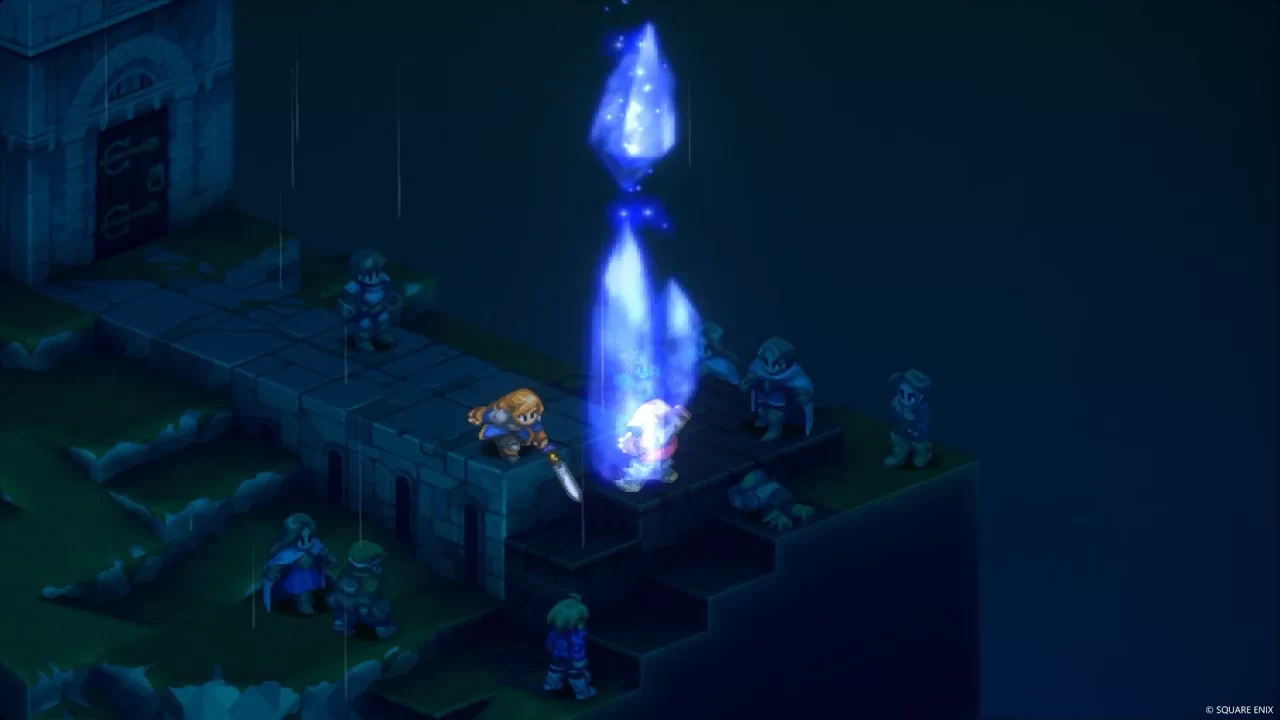
Final Fantasy Tactics returned to the center of Square Enix's plans with Final Fantasy Tactics: The Ivalice Chronicles, which is now available on Nintendo Switch 2, Nintendo Switch, PS5, PS4, Xbox Series X|S and PC via Steam. The timing makes this anniversary feel less like a museum visit and more like a check-in with a game that finally escaped old hardware in a serious way.
The Ivalice Chronicles includes an enhanced version with voiced dialogue, improved graphics, a revised interface, autosave, difficulty options, fast-forward and a tactical view. It also includes a classic version that keeps the 1997 game closer to its original form while using the War of the Lions translation. That split is smart because Tactics has two audiences now. One wants help getting past 1997 friction. The other wants to feel the old shape of the game without hunting down a disc, a PSP copy or a storefront that may not last forever.

That current availability also puts Tactics into the broader Final Fantasy moment. Square Enix has been keeping the series active across remakes, remasters and new platform pushes, including Final Fantasy 7 Rebirth's move to Switch 2 and Xbox. Tactics fits that pattern, but it also stands apart. It is not remembered because it was enormous at launch in the same way Final Fantasy VII was. It is remembered because the people who connected with it tended to carry it for decades.
Twenty-nine years later, Final Fantasy Tactics still feels unusually complete in its identity. It is a tactical RPG about systems, but never only systems. It is a political story, but never only cutscenes. It is Final Fantasy, but not trapped by what Final Fantasy looked like in 1997.
That is why the date is worth marking. On June 20, 1997, Square took one of the biggest RPG brands in the world and let it become slower, harsher and more strategic. Final Fantasy Tactics did not chase the obvious future. It built a battlefield of its own, and players are still climbing those tiles.