
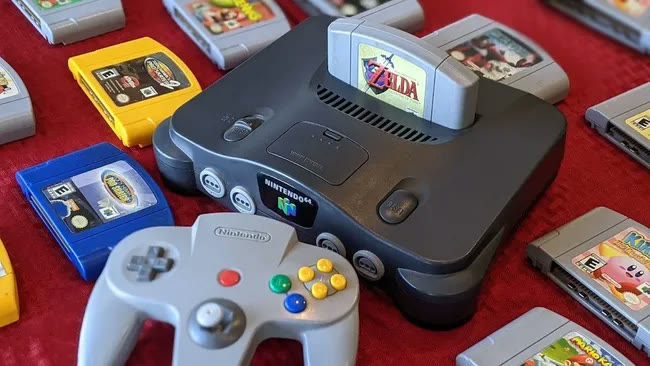
The Nintendo 64 never matched PlayStation's software volume, but its biggest games became a compact history of late-'90s console culture. This was the machine of four controller ports, cartridge prices, analog-stick experiments and Rare's impossible hot streak.
A quick caveat before the countdown: N64-era sales data is messier than modern Nintendo Switch reporting. The figures below use the best public worldwide sales or shipment numbers available, mostly gathered in Wikipedia's Nintendo 64 best-sellers table, which cites sources including the CESA Games White Papers, archived Nintendo-adjacent reporting and publisher figures. Where a number comes from a secondary or archived source, treat it as the best available public figure, not a fresh Nintendo IR update.
10. Banjo-Kazooie, 3.65 million

Rare did not just support the Nintendo 64, it helped define the console's personality. Banjo-Kazooie arrived after Super Mario 64 had already rewritten the rules for 3D platformers, then found its own lane with sharper jokes, denser worlds and a collectathon rhythm that made every jiggy feel like a small reward.
The 3.65 million figure puts it behind Nintendo's in-house giants, but that is still a huge result for a new mascot platformer on a console with a smaller install base than its Sony rival. Banjo and Kazooie became N64 icons because the game felt purpose-built for the machine: chunky worlds, bright character animation and secrets tucked behind every corner.
Source note: the 3.65 million figure is listed in the public N64 sales table, with the entry citing the 2021 CESA Games White Papers.
9. Star Fox 64, 4 million

Star Fox 64 was not the largest game on the system, but it made the N64 feel loud, tactile and new. It launched alongside the Rumble Pak in many markets, turning hits, explosions and barrel rolls into a physical gimmick that actually stuck.
The game also showed how well Nintendo could turn arcade structure into a home-console ritual. Branching routes gave repeat runs a reason to exist, the voice clips became instant playground material and the all-range boss fights made the Arwing feel far more flexible than it had on SNES. Its 4 million sales figure captures a game that was short by modern standards but endlessly replayable by N64 standards.
Source note: the 4 million figure is listed in the public N64 sales table, with the entry citing the 2021 CESA Games White Papers.
8. Diddy Kong Racing, 4.88 million

Diddy Kong Racing could have been a simple answer to Mario Kart 64. Instead, Rare built a racing adventure with a hub world, bosses, multiple vehicle types and a roster that quietly introduced future stars like Banjo and Conker.
That extra structure helped it stand apart in one of the N64's most crowded lanes. Players still got the local multiplayer chaos they expected, but the single-player campaign gave the cartridge a sense of progression many party racers lacked. At 4.88 million, it remains one of Rare's biggest commercial moments on Nintendo hardware and a reminder that the studio was not coasting on Donkey Kong Country nostalgia.
Source note: the 4.88 million figure is listed in the public N64 sales table, with the entry citing the 2021 CESA Games White Papers.
7. Donkey Kong 64, 5.27 million

Donkey Kong 64 is divisive now because of how heavily it leans into collecting, backtracking and character-specific objectives. In 1999, though, it looked like exactly the sort of giant 3D adventure N64 owners wanted from Rare and Nintendo.
The Expansion Pak bundle helped give it event-game status, while the Donkey Kong name made it feel safer than a new mascot experiment. Its 5.27 million figure shows how powerful that combination was. It sold as a technical showpiece, a familiar Nintendo brand and a huge holiday game at a time when the N64 needed late-cycle momentum.
Source note: the 5.27 million figure is listed in the public N64 sales table, with the entry citing the 2021 CESA Games White Papers.
6. Pokemon Stadium, 5.46 million

Pokemon Stadium's sales make more sense when you remember what it promised in 1999 and 2000: the Game Boy phenomenon blown up on the living-room TV. The Transfer Pak connection let players bring teams from Pokemon Red, Blue and Yellow into 3D battles, which made the N64 feel like an extension of the handheld craze rather than a separate box under the television.
The battles were the headline, but the package also understood couch play. Minigames, rentals and tournament ladders made it useful even when friends did not bring their own cartridges. Its 5.46 million figure is not just a Pokemon number, it is proof that Nintendo could bridge handheld obsession and console spectacle long before cross-platform ecosystems became normal. Gamers Now has also tracked more recent Pokemon spin-off activity, which shows how persistent that side of the brand has become.
Source note: the 5.46 million figure is listed in the public N64 sales table, with the entry citing the 2021 CESA Games White Papers.
5. Super Smash Bros., 5.55 million

The original Super Smash Bros. looks almost modest beside the gigantic crossover machine the series later became. On N64, though, the idea was wonderfully strange: Nintendo mascots knocking each other off floating stages with items, percentage meters and a control scheme that did not behave like Street Fighter or Tekken.
That simplicity was the secret. Smash worked for players who had never learned fighting-game inputs, while still leaving enough room for obsession. Its 5.55 million figure is striking because this was a new series launching late in the N64's life. Decades later, speculation about where the series goes next still matters because the N64 original turned a party experiment into one of Nintendo's most durable multiplayer brands.
Source note: Destructoid's archived Nintendo best-seller report references Smash 64 at 5.55 million, matching the public N64 sales table.
4. The Legend of Zelda: Ocarina of Time, 7.6 million

Ocarina of Time sold 7.6 million copies, but its importance has always been bigger than its sales rank. It gave players Z-targeting, a 3D Hyrule that felt coherent and a time-jump structure that turned a cartridge adventure into something mythic.
It also became one of those rare games whose reputation kept growing after its original commercial window. Later re-releases, remake rumors and constant all-time-great debates have kept it alive far beyond 1998. That long shadow is why our own look at Ocarina of Time remake rumors still finds an audience. The N64 original was not the console's best-seller, but it may be its most revered game.
Source note: The Magic Box's archived 2004 report says Nintendo revealed Zelda franchise sales at GDC and lists Ocarina of Time at 7.600 million.
3. GoldenEye 007, 8.09 million

GoldenEye 007 was the game nobody should have underestimated. Movie tie-ins had a rough reputation, console shooters were still fighting for credibility and Rare was adapting a film that had already left cinemas. Then it became the N64's great multiplayer obsession.
Four-player split-screen turned the Bond license into a social ritual. Proximity mines, Facility, Oddjob arguments and one-hit-kill slappers lived in dorm rooms and bedrooms for years. Its 8.09 million figure is massive for a licensed shooter on a Nintendo console, and it explains why GoldenEye is remembered less as a tie-in and more as a moment when console FPS design found its local-multiplayer voice.
Source note: Mental Floss's archived N64 feature lists GoldenEye 007 at 8.09 million copies, matching the public N64 sales table.
2. Mario Kart 64, 9.87 million

Mario Kart 64 is the clearest argument for why the N64 shipped with four controller ports. The SNES original invented the formula, but the N64 sequel made the series feel like a party default. Four-player split-screen, wider tracks and item chaos turned it into one of the easiest cartridges to leave in the console for months.
Its 9.87 million figure put it far above most N64 games and behind only one title on the platform. The game also set up Mario Kart's later identity as a console-defining evergreen, not just a racing spin-off. Every later Nintendo system wanted its own Mario Kart moment because the N64 proved how much hardware value a single multiplayer racer could create.
Source note: Gizmodo UK's archived Mario sales countdown lists Mario Kart 64 at 9.87 million.
1. Super Mario 64, 11.91 million

Super Mario 64 did what launch games dream of doing: it explained the machine. The analog stick, the camera buttons, the open castle hub and the shift from linear stages to 3D playgrounds all made the Nintendo 64 feel like a generational jump within minutes.
Its 11.91 million figure makes it the only N64 game publicly listed above 10 million, but the bigger achievement is how much of modern 3D platforming still traces back to it. Nintendo has made bigger Mario games since, and Gamers Now recently covered a Super Mario Galaxy 2 update from a later era of 3D Mario, but Super Mario 64 remains the foundational one. It was the console's best-selling game because it was also the clearest reason to buy the console.
Source note: Gizmodo UK's archived Mario sales countdown lists Super Mario 64 at 11.91 million.
The N64's best-seller list is unusually concentrated. Nintendo's own mascots dominate, Rare lands three games in the top 10 and almost everything here either sold the console's 3D promise or its couch-multiplayer identity. That is the N64 story in miniature: fewer releases than its biggest rival, but a top shelf that still feels ridiculously heavy.